Design is often a relatively new field for an organisation, and
articulating the value of good design — and the process to get there — is essential.
Advocating for users while establishing the practices that integrate design across
the product lifecycle is a large part of the job.
How can I add value to your
dream team?
Part 1 — Product audits
Detailed evaluation of the existing product ecosystem against usefulness,
usability, UX best practice and industry benchmarks.
Part 2 — Capability building
Understanding org structure, stakeholders, workflows and vision to evaluate
the design maturity of an organisation — then setting a foundation through the
right design system, processes, rituals and artifacts.
Part 1 — Product audits
Laying the foundation for
customer experience transformation at Zolo Stays
Zolo Stays is a co-living platform
in India providing fully managed rental accommodation, focused on comfort and
convenience for young professionals and students.
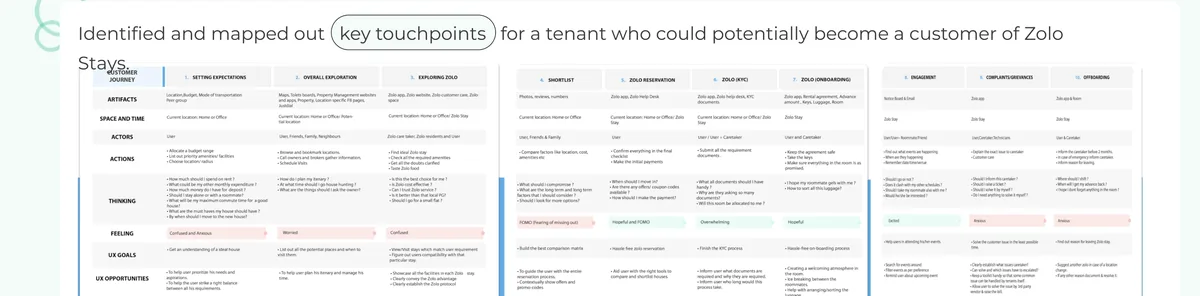
Mapping every touchpoint a tenant passes through
I identified and mapped the key touchpoints for a tenant who could
potentially become a Zolo customer — from getting information, through
exploration, shortlisting and visiting, to booking, onboarding and
living there.
Rows for artefacts, actions, thinking, feeling, UX goals and
opportunities. The feeling row is the one that earns its place — it is where
the drop-offs announce themselves before the data does.
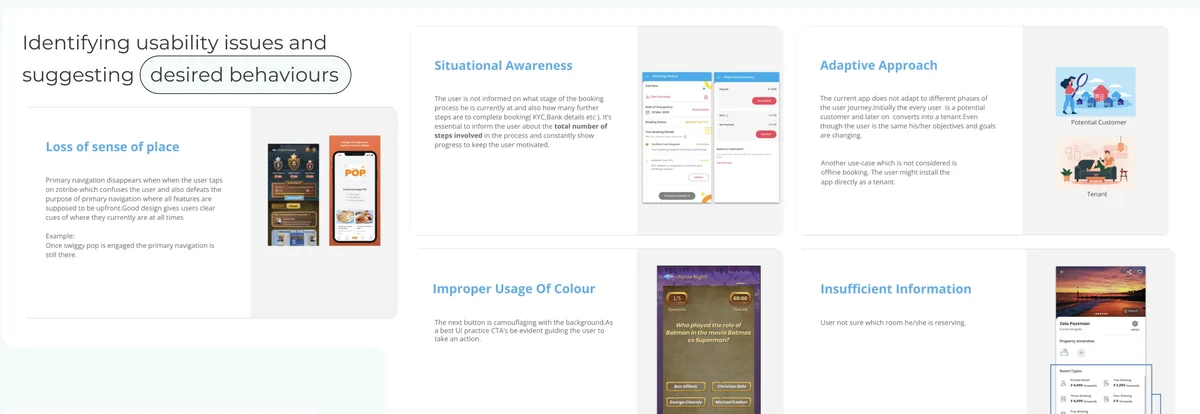
Naming the usability issues, and the behaviour we wanted instead
Each finding was paired with the desired behaviour rather than left as a
complaint — loss of sense of place answered by situational awareness,
improper use of colour and insufficient information answered by an
adaptive approach.
Problem on the left, desired behaviour on the right. Writing an
audit this way makes it actionable instead of merely correct.
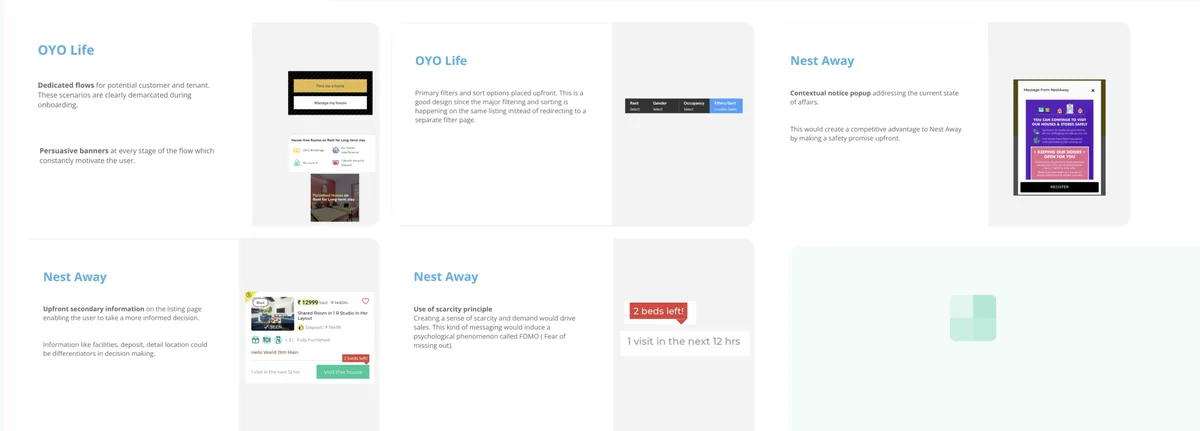
Benchmarking against the competition
Exploring competitor features and interactions — OYO Life and Nest Away —
for the patterns worth adopting and the ones worth avoiding, including
dedicated flows for potential customers and the use of scarcity principles
during booking.
Note the scarcity principle flagged on Nest Away — "3 beds left" —
recorded as an observed pattern, not an endorsement.
Part 2 — Capability building
Elevating design maturity
at Mercedes-Benz
Mercedes-Benz OTR (One Touch Retail)
is a digital retail platform that simplifies car buying by letting customers
browse, configure and purchase vehicles online.
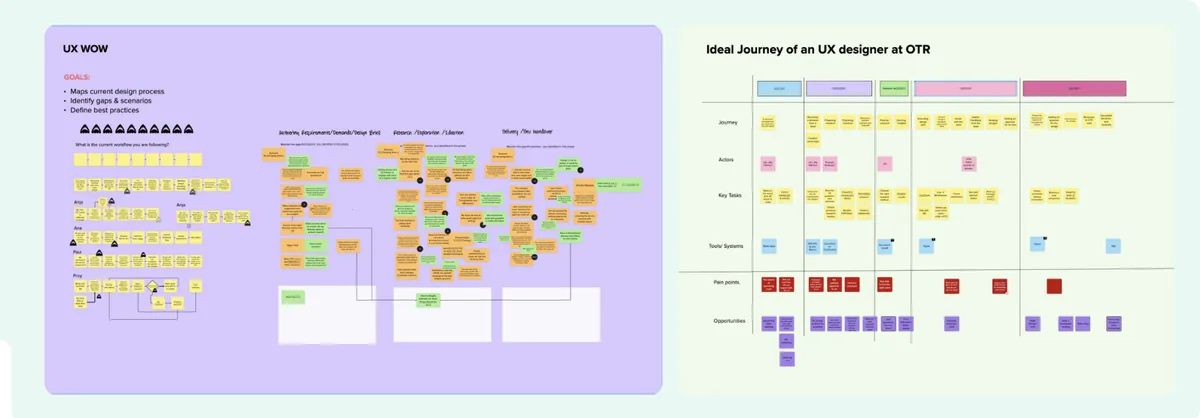
Establishing how the design team actually works
I collaborated with the entire design team to establish effective workflows
and to map the lifecycle of a design token — where it is born, who changes it,
and how it reaches production.
The design token lifecycle on the left, the designer's ideal journey
on the right. Mapping the second is what exposed the handoff gaps in the first.
Sensible defaults and a new design process
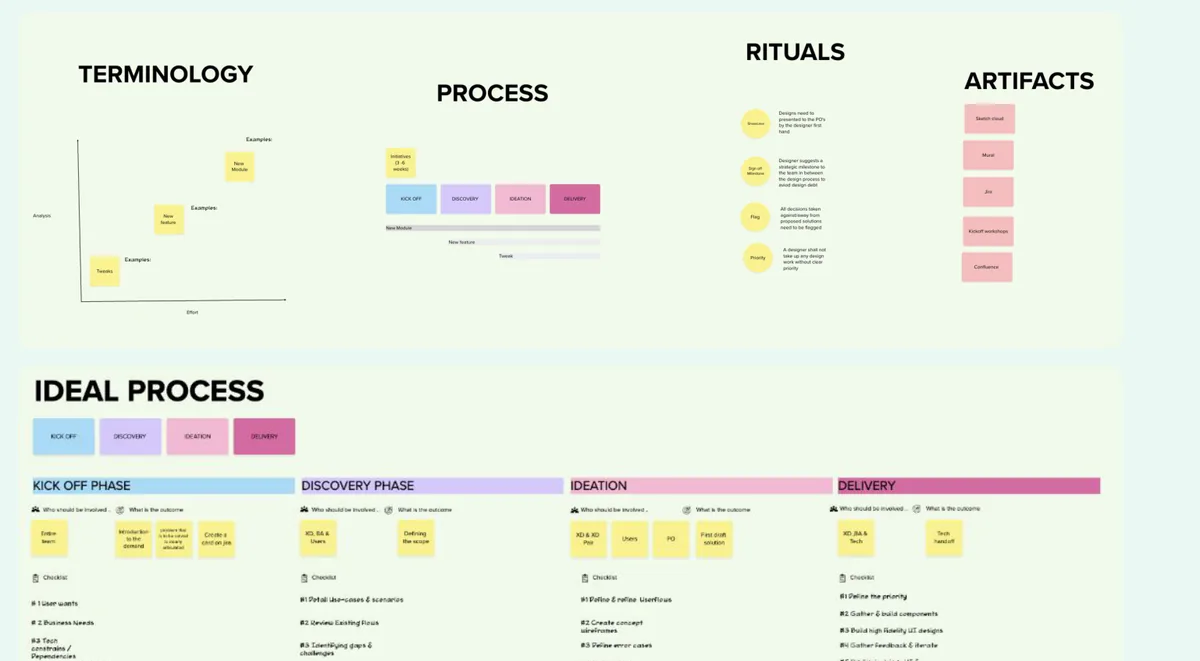
Defining the terminology, the process, the rituals and the artifacts — so that
"how we design here" stopped being tacit knowledge held by whoever had been
there longest.
Four phases — kick-off, discovery, ideation, delivery — each with its
own named rituals and expected artifacts. The point is that a new joiner can
read it.
Publishing it, so it outlived the engagement
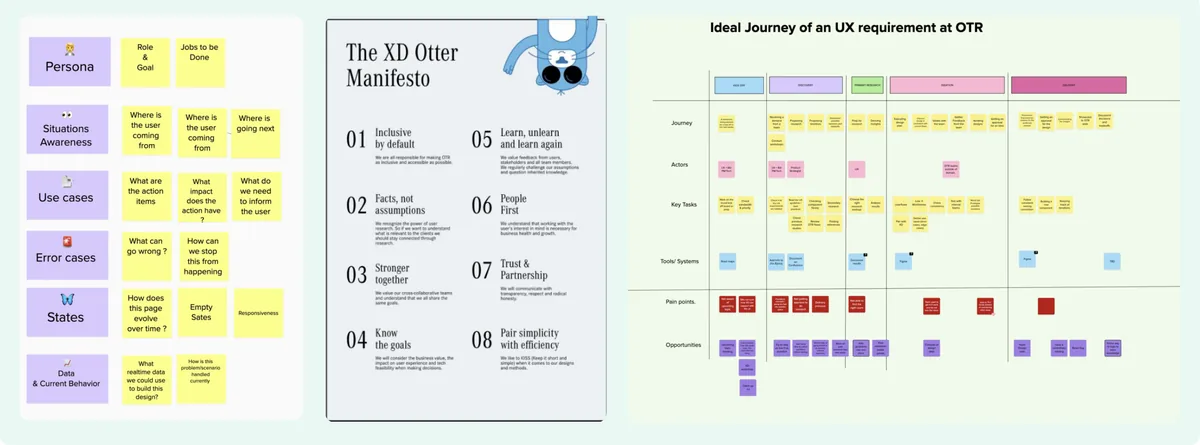
The UX sensible defaults and the XD Manifesto were published as living
artifacts: eight principles, from inclusive by default and facts over
assumptions, through to pairing simplicity with efficiency.
Left is the per-screen checklist — persona, situational awareness,
use cases, error cases, states, data and current behaviour. A manifesto without
that checklist is a poster; with it, it is a practice.
What the team said
“I like the way how you absorb all the perspectives and come up with something
that fulfils all the demands. Your work speaks for itself, it needs no
explanation.”
Thomas · Product Owner, Mercedes-Benz
“Design questions were raised and discussed in elaboration sessions, which put
Vivek under a lot of pressure to deliver designs ad hoc. He communicated that
with the team and proposed changes to the process, which put him in a more
empowered position.”
Anja · Business Analyst
“Vivek is an experienced designer with a strategic mind who knows what
ingredients are needed to create a successful service or product. He is aware
that a good product needs a solid product strategy and vision as a foundation.”
Marco · Design Strategist, Lead (OTR)
The original presentation holds the full audit and the complete set of capability
artifacts at readable size.
 Revanth Vivek Kotagiri